January 10, 2025
A FAMILY HISTORY BLOG BY LAVERNA COLSON SMITH
http://swedishrootsamericanbranches.com
A Brief Review
If you have been following my blog, you are aware that my great Aunt Ida wrote an extensive and thorough record of the descendants of Lars Carlsson, from Ödeshög, Östergötland -from 1755 through the present day of her writing, 1950. The information given to her was only partially correct and during my visit to the Vadstena, Östergötland archives I was able to find the true birth and death dates of Lars Carlsson as well as his ancestors back to the late 1500’s. Researching in pre- 1750 Sweden archives is much more difficult than later generations as record keeping improved and provided more detailed information. It has been difficult but rewarding going through old records with archaic language and spelling.

(Chart created by Family Tree Maker (2019)
WHO WAS ANDERS SKOUG?
Anders Skoug is an important figure in the ancestry of the Colson Family The above Pedigree shows Lars Carlsson’s forbears through his great grandfather, Anders Skoug, and beyond. Anders was born in 1624 in Skärstad Parish and died in 1696 in Ödeshög Parish. His wife, Dorothea Larsdotter Crantzberg, was the daughter of the Mayor of Gränna, Lars Svensson Crantzberg, and a close associate of Count Per Brahe, the founder of the town of Gränna and owner of large tracts of land and castles in the area.
Anders served in the Swedish Military as a young man and by 1660 he had been appointed by Count Per Brahe as the governmental overseer and sheriff for Ödeshög Parish as well as the Count’s castle and property above the town of Gränna in Jönköping County, Småland. The old Swedish term for overseer/sheriff/bailiff was “befallningsman.”
Family Ties
The Ödeshög Parish Clerk did genealogists a great favor by including Anders Skoug’s age at the time of his death in 1696 as 72 years of age. When Anders was appointed parish befallningsman he would have been 36 years old. He and his wife, Dorothea Crantzberg, established their residence in Ödeshög Parish about that time. There are no records of his marriage or the birth of his children however I found records of five of them. Unfortunately, estate documents were not required until 1723 and that would have given us a more complete picture of his living descendants.
Anders Skoug (1624-1696) /Dorothea Larsdotter Crantzberg (1653-1700), Marriage date and place unknown. Their known descendants are as follows:
Johannes Skoug (1666 – 1700) Pastor of Furingstad Church in Östergötland, birthplace unknown- died in Furingstad Parish, Östergötland. Married Catharina Warelia in 1700. Three children: Andreas (Jan 18, 1701), Anna Magdelena (April 14, 1702) and Dorothea (May 13, 1704)
Brigitta Skoug (1673-1729) Birthplace unknown – died in Ödeshög Parish -married Sven von Brobergen approximately 1700, marriage place possibly Skärstad Parish, Jönköping. Five children; Maria Helena (1703?), Carl Johan (Sept. 6, 1706), Dorothea (Apr 17, 1709), Gunilla Sophia (May 28, 1712 -?), Andreas (Apr 25, 1716-Jul 19, 1717)
Britta Skoug (Birth and Death place unknown)- Married Coronet Gabriel Elfving in 1711 in Ödeshög Parish. Lived on Kushult Farm, Ödeshög, Parish, until 1716 and then disappeared from the records. Two children: Anders (Sept. 19, 1711) and Elizabeth (September 3, 1713).
Elizabeth Skoug (Birth and Death place unknown) – Married Army Officer Adolph Andersson Mörk about 1690. Lived on Skougsgård (Skoug’s Farm), Skärstad Parish, until 1728 when she and her husband disappear from the records. Children: Ingeborg (1694) and Anders (1696). The son, Anders, takes the name Mörk and takes over Skoug’s Farm in 1728.
Maria Skoug (Birth and Death place unknown)- Appears in a court record and tax records but in no other documents or in any association with her siblings.
Any More Descendants??
In an age where couples had at least six, eight often 12 children, certainly Anders Skoug and his wife may have had others. The above five that I found and verified in the records are probably just the “last of the bunch.’ I found an interesting entry in the church records of Jacob Johannes Church in Stockholm. (A, AB (1643-1652)) Image 40, Arkiv Digital). Captain Anders Skoug appears in the birth and christening records of that church as the father of Beatta and Britta, twins born in on September 19, 1650. Is that our Anders Skoug? Possibly, because that high of a rank would explain his association with Count Per Brahe, the Younger, who himself was a military man. Unfortunately, no mother was named in this record but that was the custom because she had not yet been “churched.” What happened to these twins? I believe they died. The Britta born in 1650 could not have been married in 1711 and had children. Who knows what happened to Beatta.
Old Records Tell the Story
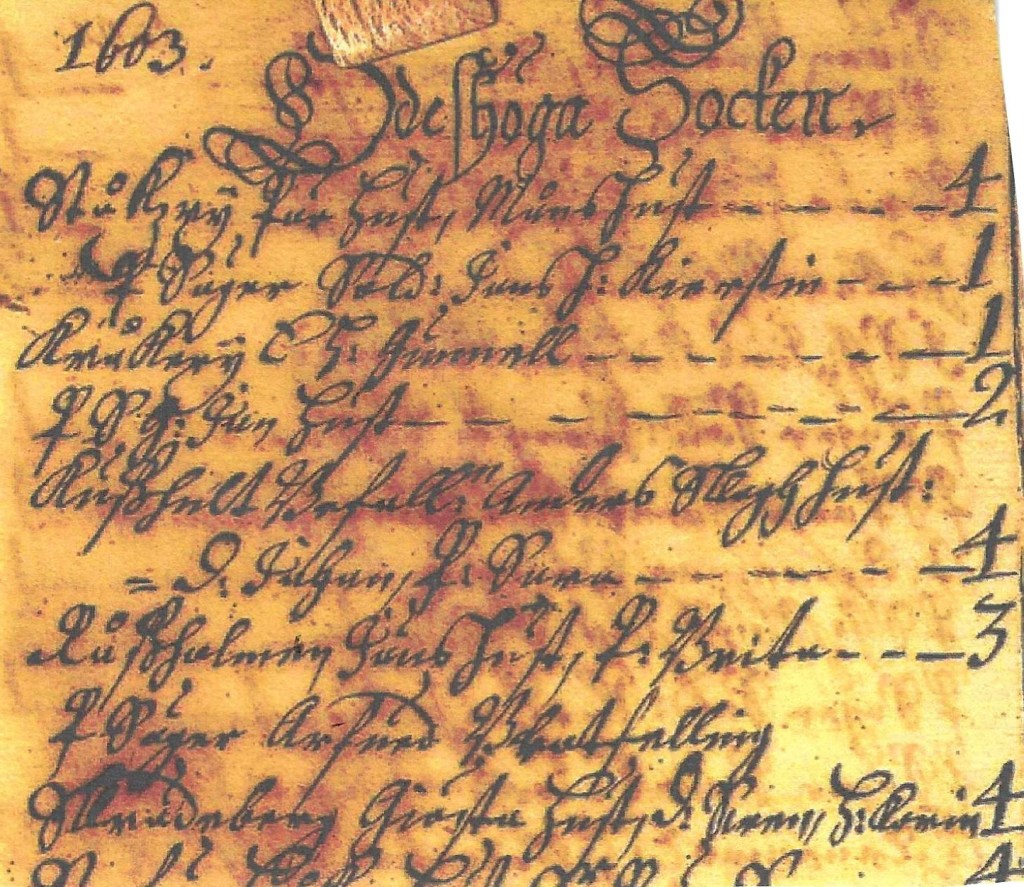
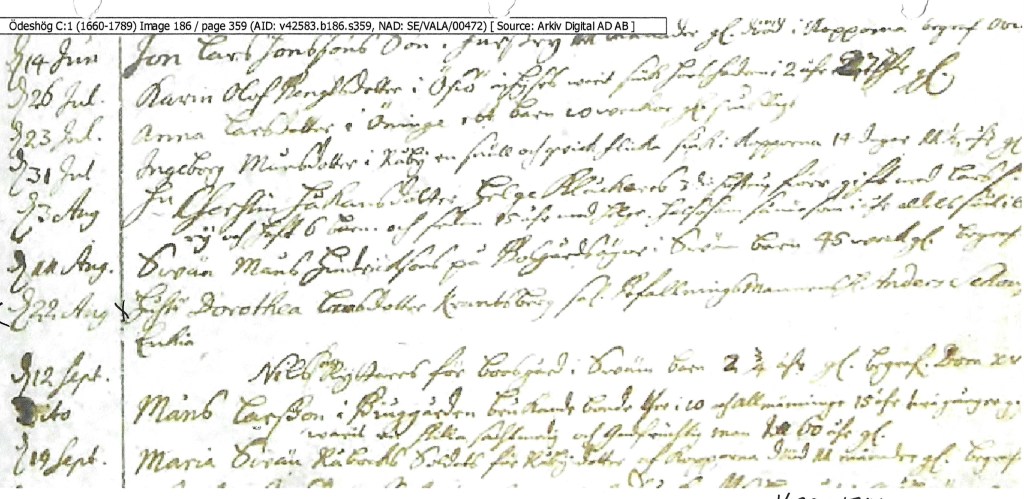
In the absence of birth and marriage records, the Swedish tax records and often death records may give ages and associations. I was able to document Maria, Britta and Brijitta through tax records as daughters living in the Skoug household as well as mentioned in court documents. I documented Johannes through a court case where he was named as the son of Anders Skoug. He also appeared in one of the tax records. The case for Elizabeth is weakest however she was living on her father’s farm with her sister Brijitta. She appears to be the oldest sister and perhaps one of the oldest children. Below is the death record for Dorothea Larsdotter Crantzberg which verifies that she was the widow (enka)of Anders Skoug, Befallningsman.
Sweden’s Age of Greatness
In any world history, or at least in my case, Scandanavian and/or Swedish history is often under studied. During the 17th Century Sweden was a great power in Europe and held the third most territory except for Spain and Russia. Sweden owned not only its present state but Finland, Estonia, Latvia, parts of Norway and northern portions of Poland and what is now Germany. Sweden fought and won back Scania (southern Sweden) from the Danes in 1625 in a remarkable winter siege. At the time, Sweden had the best trained and most formidable army in Europe.
The Great Northern War (1700-1721) changed that when a coalition of rivals consisting of Russia, Saxon Germany, Poland and Denmark challenged Sweden’s supremacy in northern Europe. The war ended with Sweden losing most of its Baltic territories and allowed Russia to become the dominant power in Northern Europe. Sweden never regained its influence after suffering both territorial and massive human loss. Sweden’s Age of Greatness came to an end.
Next Blog
Distant Colson Roots – Borgmästere (Mayor) Lars Svensson Crantzberg
Latest Posts
- THOSE WHO LEFT – THE TEN – Descendants of Carl Samuel Larsson and Rebecca Samuelsdotter – Part Two, Continued….
- THOSE WHO LEFT – “THE TEN” – Descendants of Carl Samuel Larsson and Rebecca Samuelsdotter – Part One
- THE LEGACY OF CARL SAMUEL LARSSON AND REBECCA SAMUELSDOTTER: 12 DESCENDANTS AND A LIFE WELL LIVED
- REBECCA SAMUELSDOTTER – A REMARKABLE WOMAN (1794 – 1867)
- CARL SAMUEL LARSSON (1782-1859)
Swedish Pronunciation Guide for English Speakers
The Swedish Language has 3 extra vowels and some challenging consonant combinations. Here is a quick guide to pronouncing these vowels and tricky consonants
Åå Sounds like the “o” in for
Ää Sounds like the “ai” in fair
Öö Sounds like the “ea” in earn
Y Sounds like the Y at the end of Terry
SJ,sj Pronounced like “wh” – a voiceless fricative.
K, k Pronounced like “sh” before the soft vowels of: e, i y, ä or ö

 COLSON FAMILY GENEALOGY AND HISTORY
Leave a comment