August 24, 2025
Part Two
swedishrootsamericanbranches.com
A Family History Blog By LaVerna Colson Smith
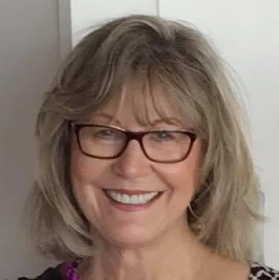
Carl Samuel Larsson (1782-1859)
Carl Samuel Larsson is a well known ancestor in the Colson Family Tree. He is my great-great grandfather and the father of twelve children. It is my privilege to tell his story.
Carl was the third of four sons born on December 27, 1782 to Lars Carlsson (1747-1786) and Maria Samuelsdotter (1756-1850) on the historic Kushult Farm in Ödeshög Parish, Östergötland. Carl’s birth in 1782 was followed by his infant brother, Samuel, who was born on January 13, 1786 and died on February 23 of the same year. Carl’s father, Lars Carlsson, died soon after on March 16, 1786 of pneumonia. Maria Samuelsdotter became a widow at age 30 with three sons: Jonas (10),Petter (8) and Carl Samuel (4). Maria’s story is told in an early blog published on June 24, 2024.
Carl Samuel’s mother remarried in 1787 to a capable young tenant farmer, Johan Nilsson, who took over management of the farm and became a surrogate father to the three young fatherless boys. Unfortunately, the young farmer, Johan Nilsson, died in 1797 at age 35 leaving Maria a widow once again. Carl Samuel, however, was 15 years of age and was able to take over the management and responsibility of the Kushult farm and Rusthåll. His dedication to duty and family remained with him until his death at age 76. (Not to worry about Maria – she remarried once again, returned to her home farm, Frebol, and died at 93 years of age.)
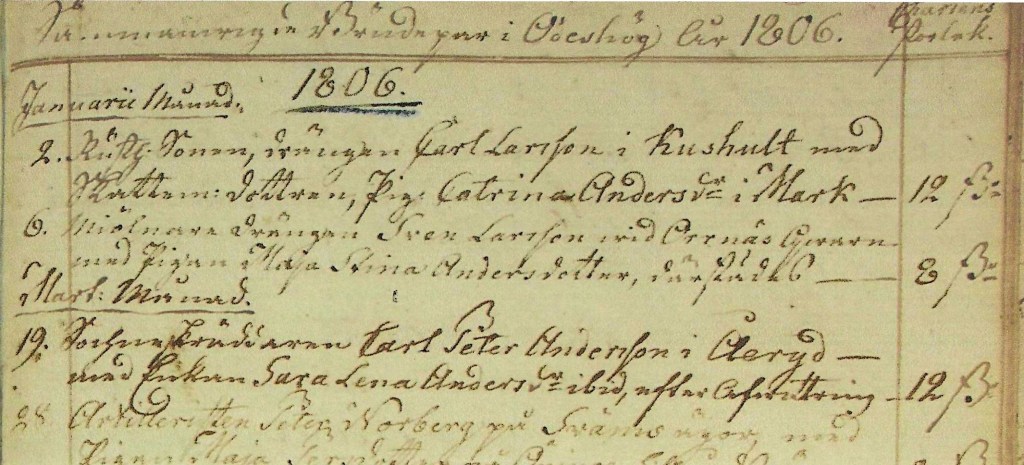
First Marriage – Catrina Andersdotter of Mark, Odeshög Parish
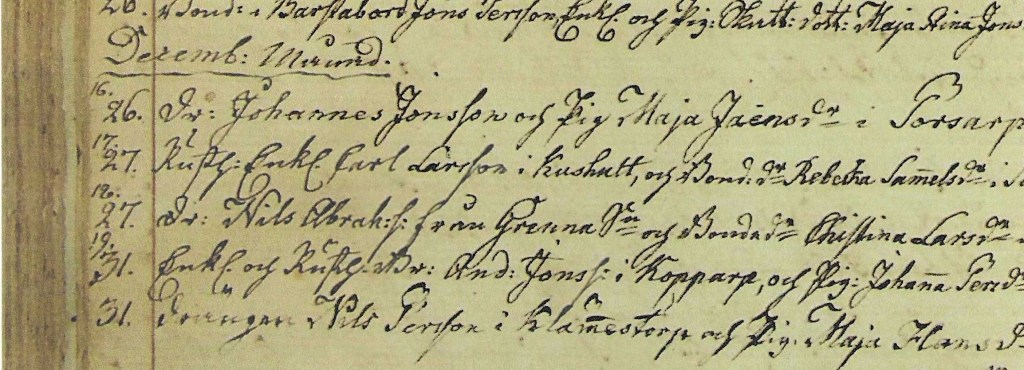
Second Marriage – Rebecca Samuelsdotter of Sunnesjö, Ödeshög Parish
Tragedy Strikes Again
Not only did Carl Samuel Larsson lose his young father to pneumonia, he lost his step father as well. Unfortunately, the deaths did not step there. His young wife, Catrina Andersdotter died of pneumonia at Kushult Farm on June 7, 1813 at only 27 years of age. She left behind two small children – Johannes, born in 1808, and Johanna, born in 1810.
Carl remarried within the year to Rebecca Samuelsdotter of Sunnesjö Farm on December 27, 1813. Rebecca was only 19 years old when she married Carl, a 31 year old widower and she immediately became a step mother to his two young children. It may have been a quickly arranged marriage, but the couple thrived. Not only did they raise Carl’s first two children; they had ten of their own and raised all of them to adulthood.
Carl and Rebecca’s 10 children became known to many as “The Ten Who Came To America.” They all thrived and I will tell their stories in an upcoming blog, “The Ten.”
An Agricultural Revolution in Sweden – The Enclosure Act
When the 15 year old Carl Samuel took over management of his farm at Kushult, agriculture was managed in the same way it had been for several centuries. It was an open field system where a farmer would cultivate only a portion of his or her land (mostly arranged in strips around the village) and the remaining was open to the other farmers to share equally in meadowland and timber. Kushult was a small village consisting of four homes and four farming families. (Originally it was a large farm owned by one of Carl Samuel’s ancestors.)
This communal type of farming started breaking up in the late 1700’s when entrepreneurial farmers began fencing off their individual pieces of land. The new system was legalized in Sweden by 1807 through several pieces of legislation knows as The Enclosure Act. In the following decades larger landowners squeezed out smaller farmers and production soared because it was a more efficient system and provided more food for a rapidly expanding population.
Not only was this an agricultural revolution, it was a societal revolution. The village system, consisting of two or more houses built close together, provided mutual aid and support. After the enclosure, many displaced farmers and farmworkers migrated to the cities to find jobs in the burgeoning industrial revolution and the new railroad system allowed them to easily move about the country. Many moved to America. Before 1850, nearly 90 % of Sweden’s population was engaged in farming; today only 8% are actively engaged in agriculture.

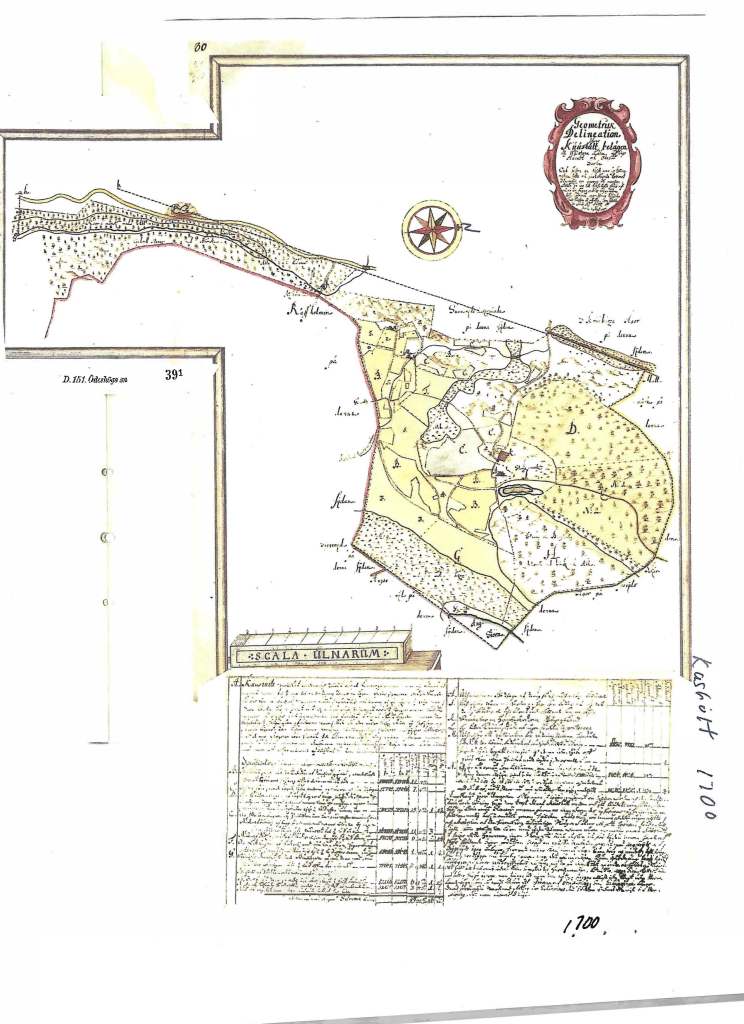
The drawing above depicts Kushult before and after the “Shift.” To the right is Kushult under the older village system in 1755 with smaller numbered land parcels and significant shared meadow and timber lands. To the left is Kushult in 1855 divided into individual farming parcels. It’s obvious this system became much more productive yet less communal in nature. The village homes, barns and outbuildings were located toward the center of the village so in many cases they had to be moved onto individual parcels.
What Happened to Carl Samuel?
In 1825, Carl Samuel Larsson sold his remaining small 1/8 mantal stake in Kushult Village and purchased a larger 3/8 mantal farm at Skrädeberg – just across the road from Kushult. It was a gorgeous piece of property overlooking Lake Vättern with timbered areas and open fields for cultivation. Carl was the last farmer on Kushult, occupied by his ancestors for over 150 years. Times had changed and Carl Samuel moved on!
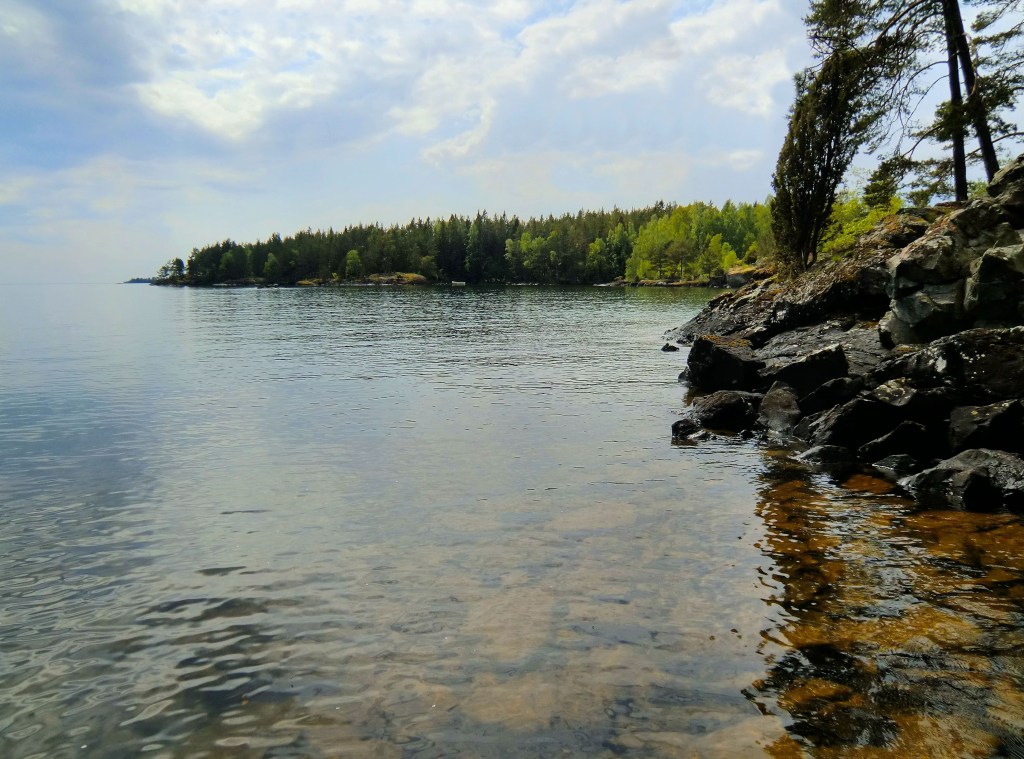
Carl lived out his life on Skrädeberg both as a farmer and a rural mail carrier. He died on September 10, 1859 at 76 years of age of pneumonia. The beautiful Skrädeberg farm was eventually sold in 1866 for 6,000 krona (SEK) to Sven Johansson of Åby Parish., Rebecca died of heart failure the following year. Carl and Rebecca’s 10 children divided the proceeds and started a new life in America.
Next Blog- Rebecca Samuelsdotter – A Remarkable Woman – Past blogs can be accessed through my website: http://swedishrootsamericanbranches.com
PAST POSTS ON COLSON FAMILY GENEALOGY
Swedish Pronunciation Guide for English Speakers
The Swedish Language has 3 extra vowels and some challenging consonant combinations. Here is a quick guide to pronouncing these vowels and tricky consonants
Åå Sounds like the “o” in for
Ää Sounds like the “ai” in fair
Öö Sounds like the “ea” in earn
Y Sounds like the Y at the end of Terry
SJ,sj Pronounced like “wh” – a voiceless fricative.
K, k Pronounced like “sh” before the soft vowels of: e, i y, ä or ö

 COLSON FAMILY GENEALOGY AND HISTORY
Leave a comment